
Oak tree removal and care in Memphis, TN
Oak is a hardwood tree of the genus Quercus, common in Memphis yards and streets. This guide covers the oaks you will see here, what goes wrong with them, and when one should be pruned, saved, or taken down.
- Free on-site estimates
- Phone answered 7 days a week
- Climbers on every job
- Full cleanup
Oak trees in Memphis at a glance
Oaks are big, long-lived shade trees, and many Memphis yards have one. Some oaks live a very long time. Others, like the water oak, wear out sooner.
Most oak trouble comes from a few things: age, drought stress, a few diseases, and pruning at the wrong time of year. Some of it can be managed. Some of it means the tree has to come down.
This is a general guide. Only an in-person look can tell you what is wrong with your tree.
Which oaks grow in Memphis?
Willow oak, water oak, southern red oak, and pin oak are the ones most people run into around the Mid-South. If you want a quick look at what we do, see our main tree service in Memphis page.
Willow oak grows along the lower Mississippi valley and gets tall, from about 80 to 120 feet in the wild. It is a popular shade tree because it transplants easily. Water oak is native to southwestern Tennessee and the rest of the Mississippi valley and is widely planted as a street and yard tree across the South. Southern red oak is listed for Tennessee, Mississippi, and Arkansas, usually reaches 70 to 80 feet, and can live about 150 years. Pin oak is a common yard planting and belongs to the red oak group.
Sources: USDA Forest Service, willow oak, USDA Forest Service, water oak, University of Tennessee, water oak, USDA Forest Service, southern red oak, Tennessee Division of Forestry on oak wilt.
What problems do oaks get here?
Four problems come up again and again on Memphis oaks: oak wilt, hypoxylon canker, bacterial leaf scorch, and pin oak chlorosis. Our arborist in Memphis page covers these too.
Oak wilt
A fungus that blocks water movement in the tree. Beetles carry it to fresh wounds, and red oaks are hit harder than white oaks. Details are in the oak wilt section below.
Hypoxylon canker
A fungus that moves in on trees already stressed, especially after a long drought. Look for dieback from the top and bark sloughing off in patches. Treatment options are few, and the tree can die soon after the crusty mats show.
Bacterial leaf scorch
Leaf edges brown in mid to late summer, a bit more each year. Leafhoppers spread it. There is no cure, and affected trees decline over several years.
Pin oak chlorosis
Leaves go yellow while the veins stay green. High soil pH keeps the tree from taking up iron. It can be treated, but not planting pin oak in high pH soil is the better fix.
Many of these look alike. Scorched leaves can mean drought, leaf scorch, or oak wilt, so it takes a trained eye to tell.
Sources: Tennessee Division of Forestry on oak wilt, Tennessee Division of Forestry on hypoxylon canker, Tennessee Division of Forestry on bacterial leaf scorch, University of Missouri Extension on bacterial leaf scorch on oak, Iowa State Extension on pin oak chlorosis.
When does an oak need to come down?
An oak needs to come down when it is dead, mostly dead, or structurally unsound and it can hit something that matters. The risk is what counts, not just how the tree looks.
Signs that point toward removal:
- Half or more of the crown is dead or damaged
- Large cracks or splits in the trunk, or a trunk that is hollow or soft inside
- Mushrooms or decay at the base, or soil heaving up on one side
- A new lean toward the house, driveway, or play area
Water oaks deserve extra attention. Sources put their life span at only 30 to 50 or 60 to 80 years, and older trees rot. Their limbs are known to break in wind, snow, and ice. A big old water oak over a house is worth a hard look.
Not sure if yours is on the list? Read dead tree signs or see how we handle tree removal in Memphis. If a limb or trunk is already on the house, start with what to do when a tree is on your house.
Sources: Arbor Day Foundation, when to remove your tree, UGA Extension, hazardous trees, NC State Extension, water oak, University of Alabama Arboretum, water oak.

When should you prune an oak?
Prune oaks outside March through July. The Tennessee Division of Forestry asks people to avoid pruning oaks in those months, because that is when the beetles that carry oak wilt are most active.
The reason is the wound. A fresh cut, or a limb torn off by a storm, is an open door for the fungus. Cutting in the cooler months, when the beetles are not flying, lowers that risk. For the wider seasonal picture, see our notes on the right season to trim trees.
A dead or dangerous limb is different. If something could fall on a person or a roof, do not wait for a better month. Call us, and we will talk through the safest way to cut it. We also do tree trimming and pruning on healthy oaks to thin and lift the crown.
What is oak wilt and is it in Tennessee?
Oak wilt is a fungus disease that blocks water movement inside an oak and kills it. The state says it has been found in Tennessee in the past, but it is not considered established across the state, and no recent detections have been made.
The state treats it as the most important oak disease in the eastern United States. Red oaks, such as pin, southern red, and black oak, are hit harder than white oaks. Leaves in the upper crown wilt, turn olive, then brown from the tips inward. Red oaks can drop leaves fast.
The fungus can also move between nearby oaks through joined roots. If you think your oak has it, report it to the Tennessee Division of Forestry. Wood from a diseased tree should be covered tightly in plastic for at least a year or burned right away, so ask your tree service what they do with it.
Are oak galls a problem?
Usually not. Galls are swellings made of plant tissue, caused by insects. Most leaf galls cause little or no harm to the tree and are mainly an eyesore.
A few can make leaves drop early. Galls on twigs and branches are the ones to watch, because a heavily infested tree can be hurt or even killed by them. Acting early helps. Pruning off infested twigs while the galls are small helps, and raking up and getting rid of fallen infested leaves also helps.
Once a gall has formed, it is nearly impossible to undo. Sprays are rarely worth it.
Sources: Penn State Extension on galls on oak.
Why do big oaks need a crane or rigging?
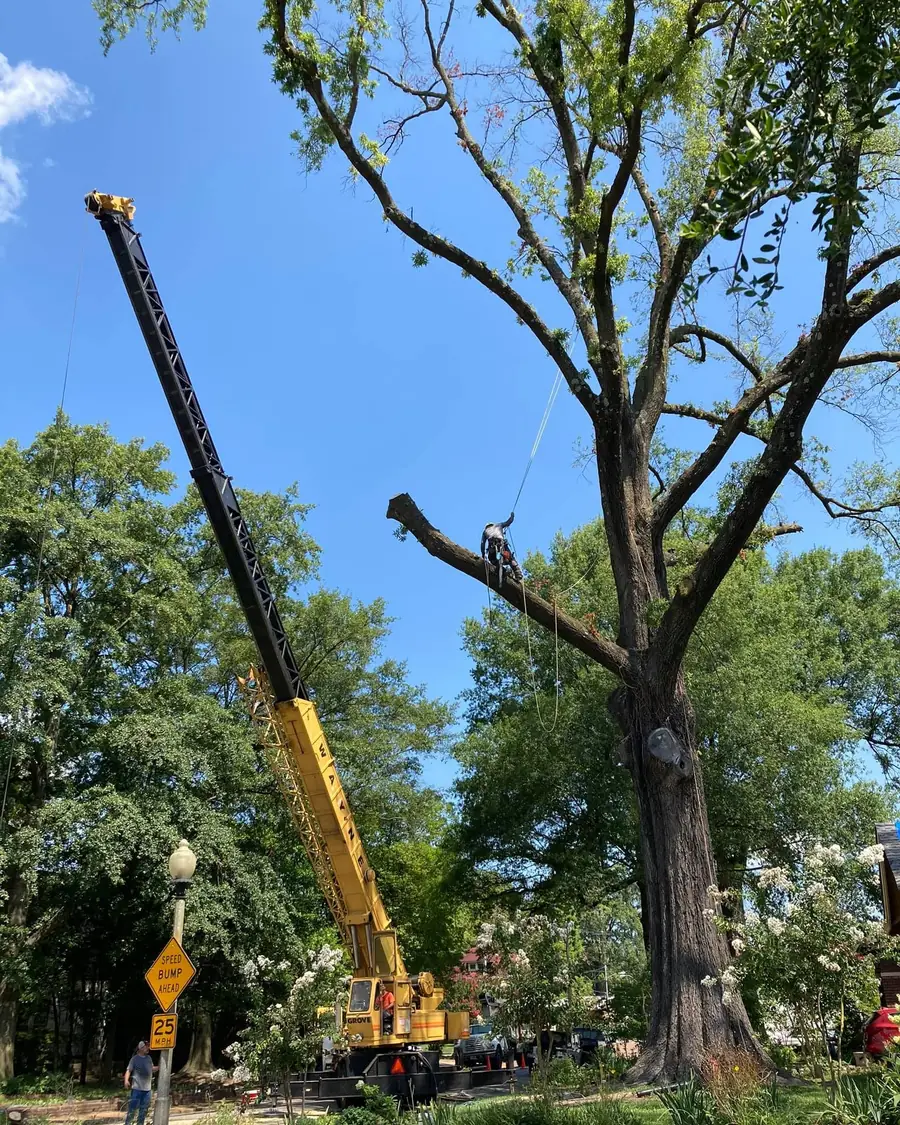
Big oaks need a crane or rigging because they are heavy and tall, and they usually stand near a roof, a fence, or a line. Dropping one in a single piece would put all that weight where you do not want it.
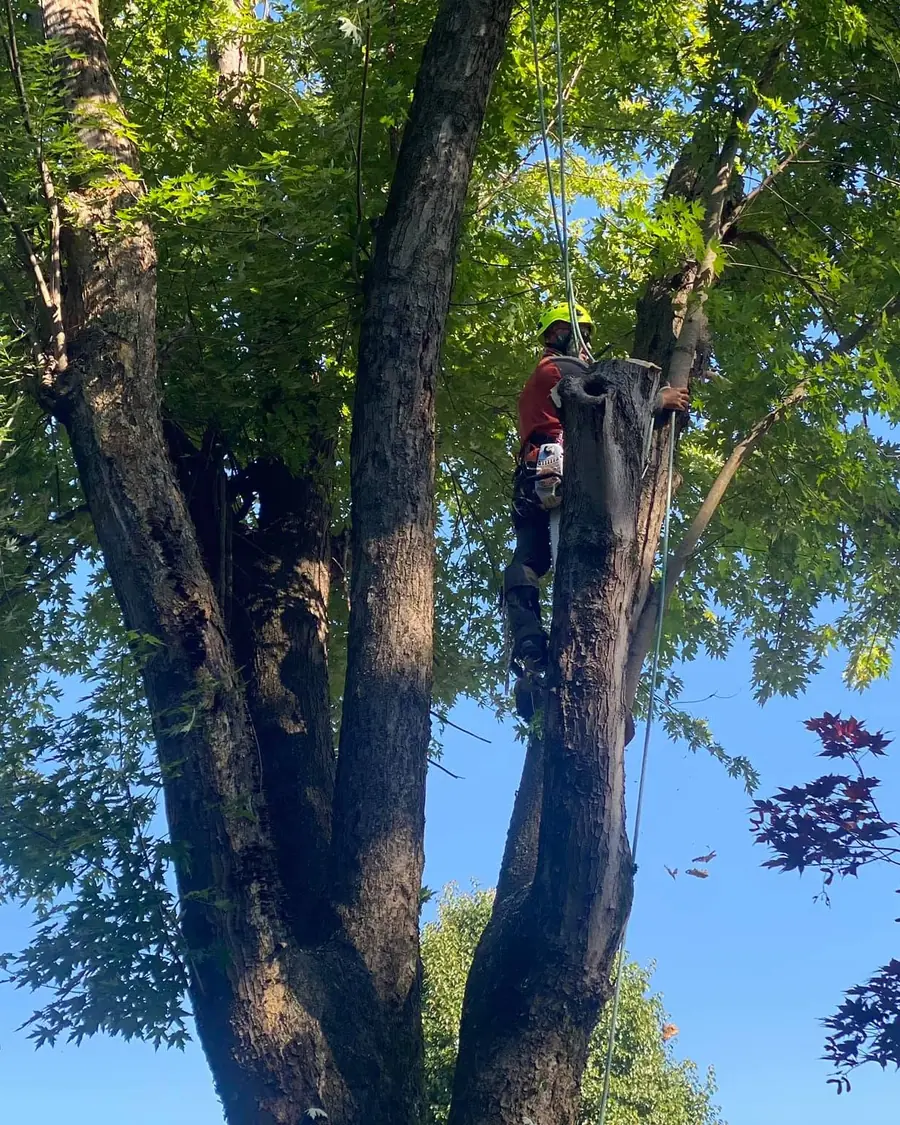
So the tree comes down in sections. A climber ties in, cuts a piece, and lowers it on ropes. When the tree is too large or too far gone to climb, or it leans over the house, a crane can hold each piece while it is cut and swing it clear. We do crane-assisted removals for these jobs. Whether a crane makes sense depends on the tree and the space, and we decide that at the free on-site estimate.

Can an oak be saved?
Sometimes. Many oaks recover when the problem is stress, and cannot when the disease is one with no cure. Here is how to tell which path you are on.
- Take away the stressWater deeply through dry spells, keep heavy equipment and fill soil off the roots, and skip fertilizer unless it is needed.
- Know the limitsBacterial leaf scorch has no cure. Hypoxylon canker has few options. If more than half the top of the tree died in one season, it probably will not come back.
- Treat what can be treatedPin oak chlorosis can be handled with iron treatments, and a trained arborist can say if trunk injections are worth it on a valuable tree.
- Decide with risk in mindIf the tree is sick and leans toward the house, removing it while it still has some life can cost less than waiting.
Sources: Minnesota DNR, oak decline management, Tennessee Division of Forestry on bacterial leaf scorch, University of Missouri Extension on bacterial leaf scorch on oak, Tennessee Division of Forestry on hypoxylon canker, Iowa State Extension on pin oak chlorosis.
Oak questions
What time of year can you prune an oak?
Avoid March through July, when the beetles that spread oak wilt are most active. Outside those months is the better window for routine pruning. Dead or hanging limbs that are a danger should still be dealt with right away.
Is oak wilt in Tennessee?
The Tennessee Division of Forestry says it has been found in the state in the past, but it is not considered established across Tennessee and there have been no recent detections. They ask people to report suspected cases.
Are oak galls bad for my tree?
Most leaf galls do little or no harm. Galls on twigs and branches can hurt a tree that is heavily infested, so those are worth getting looked at.
How long do water oaks live?
Not long for an oak. Extension and arboretum sources give 30 to 50 years, or 60 to 80 years, and older trees are prone to rot. Their limbs are also known to break in wind and ice.
Do I need a permit to remove an oak?
It depends on the city and the tree. Our guide to Memphis tree permits explains the basics. This is general information, not legal advice.
Got an oak you are unsure about?
Free estimates. Phone answered 7 days a week.