
Arborist in Memphis, TN: Tree Health, Risk and Honest Advice
Arborist service is the study and care of tree health and structure by a tree care professional. At 18 Primos Solutions, that means a close look at a tree you're worried about and a plain answer on what it needs: pruning, support, more time, or removal.
- Free on-site estimates
- Phone answered 7 days a week
- Pruning and cabling plans
- Honest save-or-remove advice

This page explains what an ISA Certified Arborist is, the tree problems that show up most in Memphis, how roots and building work hurt trees, what we check on a visit, the signs that a tree needs a look, what goes into a pruning plan, and how to decide between saving a tree and taking it down. Estimates are free, and our own team answers the phone at (901) 389-2360, Monday to Saturday 7am to 9pm and Sunday 6am to 8pm.
What is an ISA Certified Arborist?
An ISA Certified Arborist is a person who has passed the International Society of Arboriculture's certification exam and keeps the credential current with ongoing training. Tree service in Memphis crews vary a lot, and this credential belongs to one person, not to the company they work for.
To sit for the exam, a person needs at least three years of full-time tree work, or a mix of schooling and fewer years on the job. The exam is 200 multiple-choice questions in three and a half hours. ISA calls the program voluntary, and the certificate is personal, so it can't be handed to anyone else.
The credential lasts three years. To keep it, an ISA certified arborist earns at least 30 continuing education units in that time or passes the exam again.
So when any company says it has a certified arborist, the useful question is who. Ask for the person's name and certification number. ISA's Find an Arborist directory, which replaces its older Verify a Credential tool, lets you look a person up by name or by number.
Sources: ISA Certified Arborist guide, ISA, Find an Arborist directory FAQ (January 2026).
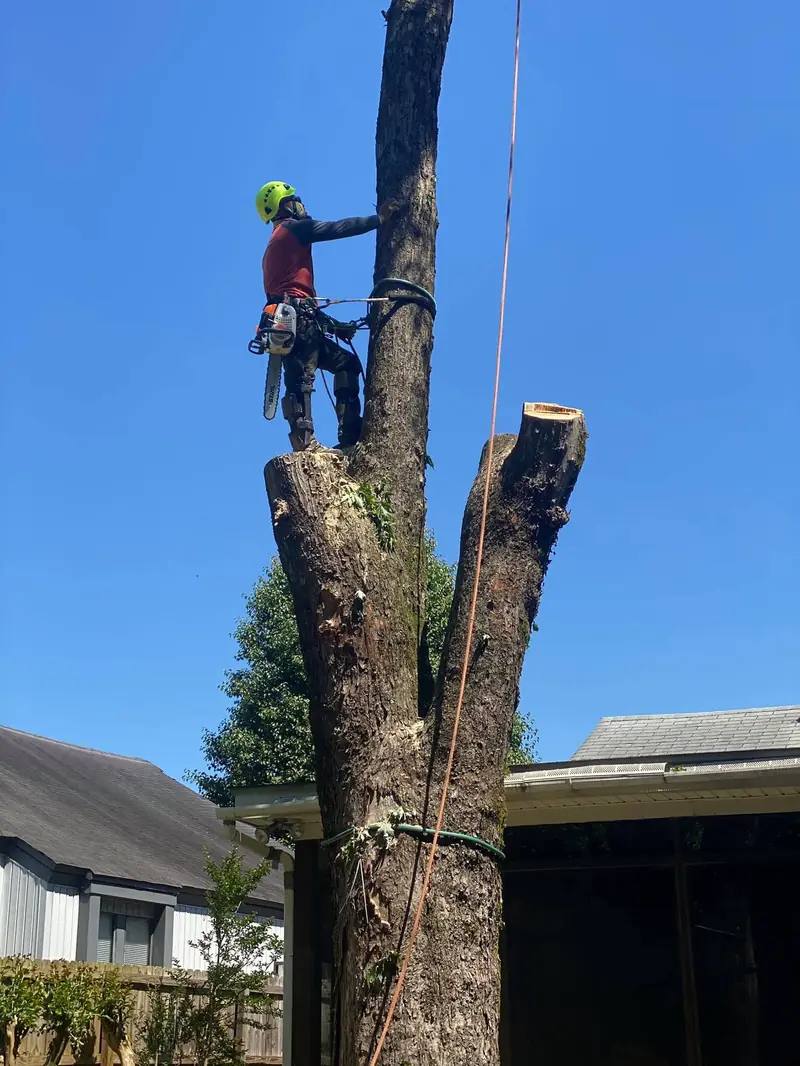
Which tree problems do we look for in Memphis?
These are the six tree problems we look for most on Memphis trees: bacterial leaf scorch, hypoxylon canker, oak wilt, emerald ash borer, pin oak chlorosis and fall webworm.
Bacterial leaf scorch
Brown, scorched leaf edges in late summer that come back worse each year. It hits pin, red and scarlet oaks, plus elm, sweetgum, sycamore and red maple. Leafhoppers spread it, and there's no cure.
Hypoxylon canker
Bark peels off to show a crusty tan to black fungus. It shows up most in big, mature trees after long dry spells. By the time you see it, the wood is often badly decayed.
Oak wilt
Found in Tennessee in the past, with no recent detections, according to the state Division of Forestry. The main way to prevent it is not pruning oaks from March through July.
Emerald ash borer
A beetle that kills ash trees. It was first found in Tennessee in 2010 and has been confirmed in more than 60 counties. If you have a big ash, have it looked at.
Pin oak chlorosis
Pale yellow leaves with green veins. Soil with a high pH locks up iron, which is common where pin oaks were planted near concrete and fill.
Fall webworm
Silky tents on the ends of pecan and persimmon branches in late summer. It looks bad, but losing the leaves usually doesn't kill a healthy tree.
Several of these look alike from the ground. Our oak trees in Memphis guide covers the oak problems in more detail. Many trouble spots don't start in the leaves at all, though. They start underground.
Sources: UT Extension on bacterial leaf scorch, Tennessee Division of Forestry on hypoxylon canker, Tennessee Division of Forestry on oak wilt, Tennessee Division of Forestry on emerald ash borer, Iowa State Extension on pin oak chlorosis, Mississippi State Extension on fall webworms.
What about roots, soil and construction damage?
Root damage is a common reason big trees decline, and it's usually caused by digging, grading or driving near the tree. Most roots here sit in the top 18 inches of soil, and more than half are in the top 6 inches, according to the Memphis Area Master Gardeners.
The Memphis area sits on deep loess, a fine, wind-blown silt. That's why a new driveway, a trench for a sewer or gas line, a pool, or heavy equipment parked under a tree can kill it a few years later. The roots you can't see take the hit. If you're planning work near a big tree, have it looked at first. Fencing off the root zone or moving a trench to one side can save it.
The same shallow roots explain why so many trees tip over when the ground is soaked and a storm hits.
Tree roots and foundations are a common worry too. Some trees cause more trouble than others. Silver maple roots, for example, are known for getting into sewer lines and lifting sidewalks, so plant them well away from the house.
Sources: Memphis Area Master Gardeners on tree roots, USDA, Memphis soil series, University of Missouri Extension on silver maple.

What does the arborist check on a visit?
An arborist visit is a close look at a tree that ends with a clear plan. We check six things:
- Tree healthLeaves, bark and canopy, for signs of disease, pests and stress common in Memphis oaks, maples and pines.
- Structure and riskWeak forks, cracks, decay, root problems and lean, plus what the tree would hit if it failed.
- Pruning needsWhat to cut, how much, and when, so the tree grows stronger instead of weaker.
- Cabling and supportWhether a weak fork can be held together with a cable or rod.
- Save or removeA straight answer on whether the tree is worth keeping, and what removal would take if it isn't.
- Rules to checkSome towns, like Lakeland, have their own tree permit rules. We'll tell you when it's worth checking with the town before anything is cut.
What signs mean a tree needs an arborist?
A tree needs an arborist when you see dead branches at the top, leaves that brown or drop early, or bark falling off the trunk. Mushrooms at the base, new cracks or splits, and a fresh lean are signs too.
One sign alone doesn't always mean the tree is dying. Drought can brown leaves, and a tree that's bare in winter is usually just dormant. A mix of signs, or any sign on a big tree over the house or driveway, is worth a look. Our guide to signs a tree is dying walks through each one, including a simple scratch test you can do yourself.
When a sign does show up, the next question is often who should look at the tree.
Why hire a certified arborist?
Hire a certified arborist when you need a trained, tested opinion on a tree, such as for a permit, a home sale, an insurance question, or a big tree you want to keep. The person has passed ISA's exam and has to keep learning to stay certified, which is a good starting point.
A person holds the certificate, not the company. So ask any company you call for the name of the certified arborist and the certification number, then look that person up in ISA's Find an Arborist directory. ISA also says a certificate isn't proof of good work, so use it along with proof of insurance, a written estimate and references.
Some towns ask for one. Lakeland's tree removal permit, for example, calls for trees to be checked by a certified arborist. When a permit or a plan needs that sign-off, get it from the credential holder. Our crew can then do the pruning, cabling, crane work or removal the plan calls for. The checklist on how to hire a tree service covers the other questions to ask.
Sources: ISA Certified Arborist guide, ISA, Find an Arborist directory FAQ (January 2026), ISA, Why Hire an Arborist, Lakeland city code.
What is in a pruning plan?
A pruning plan says which branches come off a tree, how much of the crown goes, and when the work should happen. Every cut has a reason, because each cut changes how the tree grows.
- Cleaning
- Taking out dead, dying, diseased and weakly attached branches.
- Thinning
- Cutting back some outer growth to let wind and light through.
- Raising
- Taking off low limbs to clear the roof, driveway or sidewalk.
- Reduction
- Making the tree smaller with proper cuts that keep its shape.
ISA's guide says no more than 25% of the crown should come off at once, and less on a mature tree. Each cut goes just outside the branch collar, the swollen ring where a branch meets the trunk, not flush with it. ISA also says most experts don't recommend wound paint.
Timing matters too. For oaks, the Tennessee Division of Forestry asks people not to prune from March through July, when the beetles that spread oak wilt are most active. Dead or hanging limbs are the exception, since they need to come down right away.
If pruning alone can't fix a weak fork, the plan may add a cable or rod to support it. Our tree trimming in Memphis page covers the trimming side.
Sources: ISA, Pruning Mature Trees, Tennessee Division of Forestry on oak wilt.
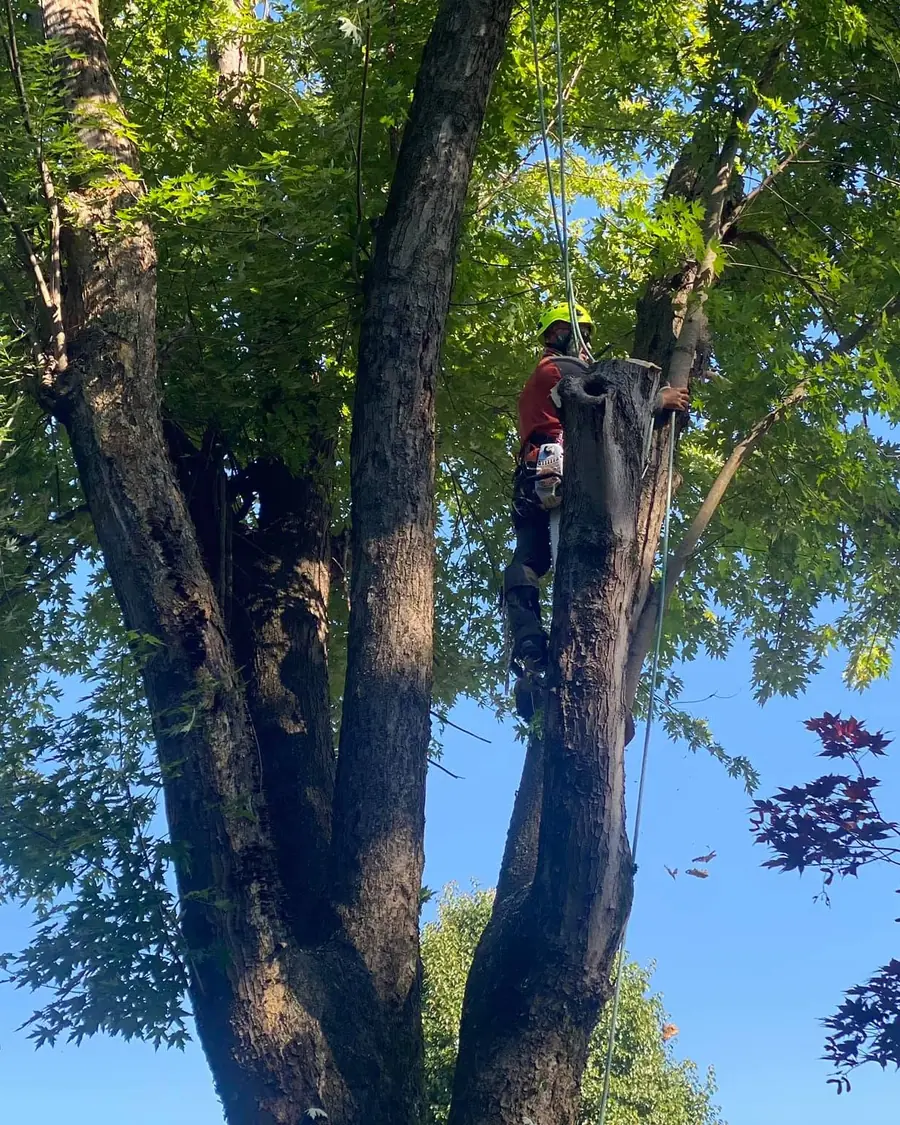
Should you save the tree or remove it?
Save the tree if the trunk and main roots are sound and the problem can be managed. Remove it if decay has reached deep into the trunk, the roots have failed, or a problem with no cure has the tree in steady decline over something it could hit.
A lot of trees can be brought back. Cutting out dead wood, protecting the root zone, fixing water problems and supporting a weak fork all help. Some problems can't be fixed. Bacterial leaf scorch has no cure, though a tree can hang on for years. Hypoxylon canker usually means the wood is already decayed, which matters most when the tree stands over a house.
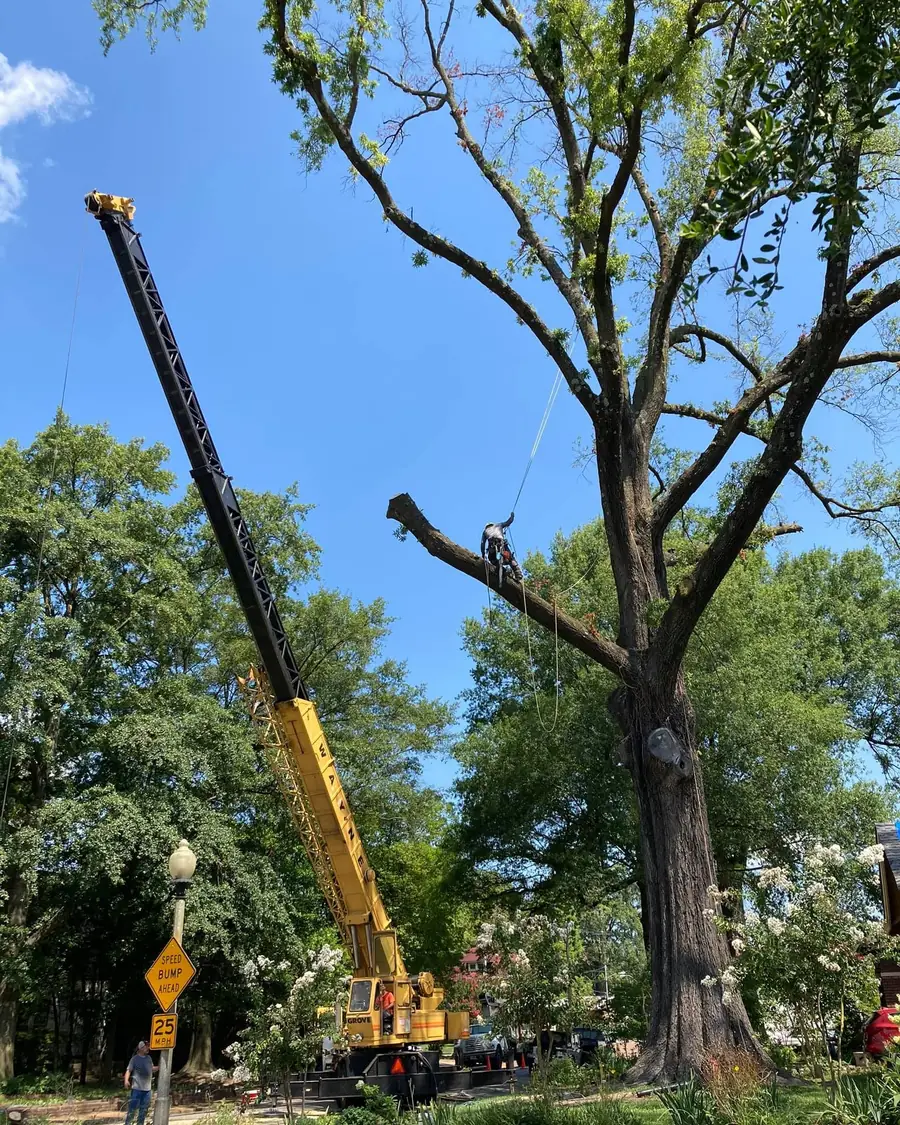
If the tree can't be saved, our crew handles tree removal in Memphis, with climbers and a crane when a tree is too big or too close to the house. Either way, we talk through the price before we start.
Sources: UT Extension on bacterial leaf scorch, Tennessee Division of Forestry on hypoxylon canker.
Want a tree looked at?
Free estimates. Call Monday to Saturday 7am to 9pm, Sunday 6am to 8pm.